In this episode, we talk with neuroscientist Prof. Sebastian Markett about the “dopamine detox” trend, his day-to-day research, and why neuroscientific explanations sound so convincing, as well as where their limits lie.


Was ist Dopamine Detox? Mythos oder Wahrheit – Psychologie erklärt
Is Dopamine Detox a Myth? –
With Sebastian Markett
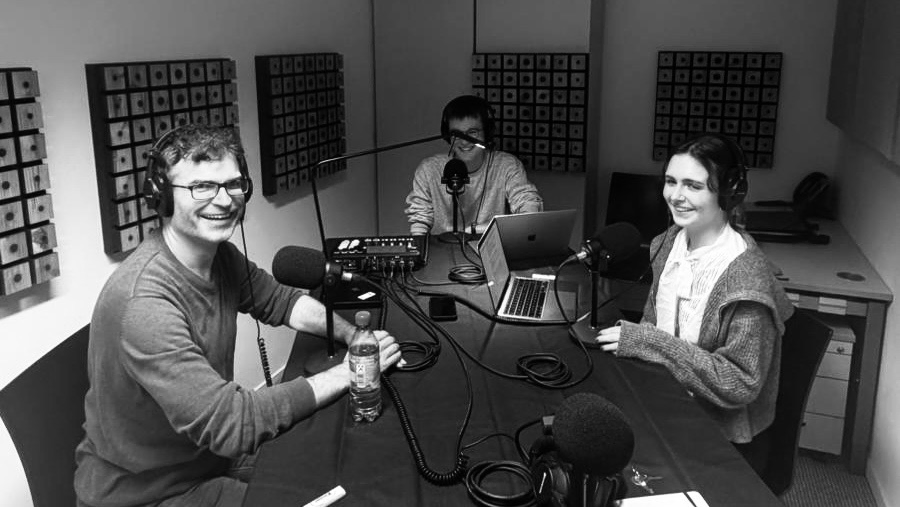
About this episode
“We can’t really do a dopamine fast, but we can give up certain behaviors.”
“With social media, someone has built a system that hijacks a system we already have in our brains.”
“‘Everything that makes us who we are is ultimately just neurochemistry in the brain.’ You could certainly make that kind of reductionist argument.”
“We are the masters of nuance, of shades of gray, and of not wanting to commit. And that has been built into the scientific method for good reason.”
Our guest
This episode’s guest is Prof. Sebastian Markett.
Prof. Sebastian Markett is Professor of Molecular Psychology at Humboldt University of Berlin, where his research focuses on functional brain connectivity, genetic influences on cognitive processes, working memory, and individual differences in personality and behavior.
Here you can find more information about our guest:
- Website: https://www.psychologie.hu-berlin.de/de/mitarbeiter/1690627
- List of publications: https://www.psychologie.hu-berlin.de/de/mitarbeiter/1690627/publications
- Research project Schusseligkeit (absent-mindedness): https://schusseligkeit.de
- Research project on neuroticism: https://gepris.dfg.de/gepris/projekt/557721320?c
- Instagram: https://www.instagram.com/neuroproof
- YouTube: https://www.youtube.com/@neuroproof
The conversation in this episode is led by the podcast hosts Maria Saryusz-Wolska and Malte Cox. This episode is in German.
We would like to thank our guest Prof. Sebastian Markett very much.
Sources
Guest
Interview with Prof. Sebastian Markett (March 10, 2026, Menschlich Podcast)
Sources
1. Media source on the origin of the term Dopamine Detox
Bowles, N. (2019, 7. November). How to feel nothing now, in order to feel more later. The New York Times. https://www.nytimes.com/2019/11/07/style/dopamine-fasting.html
2. Data source Google Trends on the term Dopamine Detox
Google. (o. J.). Google Trends: Dopamine detox. Abgerufen am 10. März 2026, von https://trends.google.de/trends/explore?date=all&q=Dopamine%20Detox&hl=de
3. Studies on reward processing
Schultz, W., Apicella, P., & Ljungberg, T. (1993). Responses of monkey dopamine neurons to reward and conditioned stimuli during successive steps of learning a delayed response task. The Journal of Neuroscience: The Official Journal of the Society for Neuroscience, 13(3), 900–913. https://doi.org/10.1523/JNEUROSCI.13-03-00900.1993
Schultz, W., Dayan, P., & Montague, P. R. (1997). A neural substrate of prediction and reward. Science, 275(5306), 1593–1599. https://doi.org/10.1126/science.275.5306.1593
Schultz, W. (1998). Predictive reward signal of dopamine neurons. Journal of Neurophysiology, 80(1), 1–27. https://doi.org/10.1152/jn.1998.80.1.1
4. Study on neuro-appeal
Fernandez-Duque, D., Evans, J., Christian, C., & Hodges, S. D. (2015). Superfluous neuroscience information makes explanations of psychological phenomena more appealing. Journal of Cognitive Neuroscience, 27(5), 926–944. https://doi.org/10.1162/jocn_a_00750
Projects and databases mentioned in the episode
UK Biobank: https://www.ukbiobank.ac.uk
Human Connectome Project: https://www.humanconnectome.org
Neurosynth: https://neurosynth.org
