Interview with Prof. Fritz Günther (May 27, 2026, Menschlich Podcast)


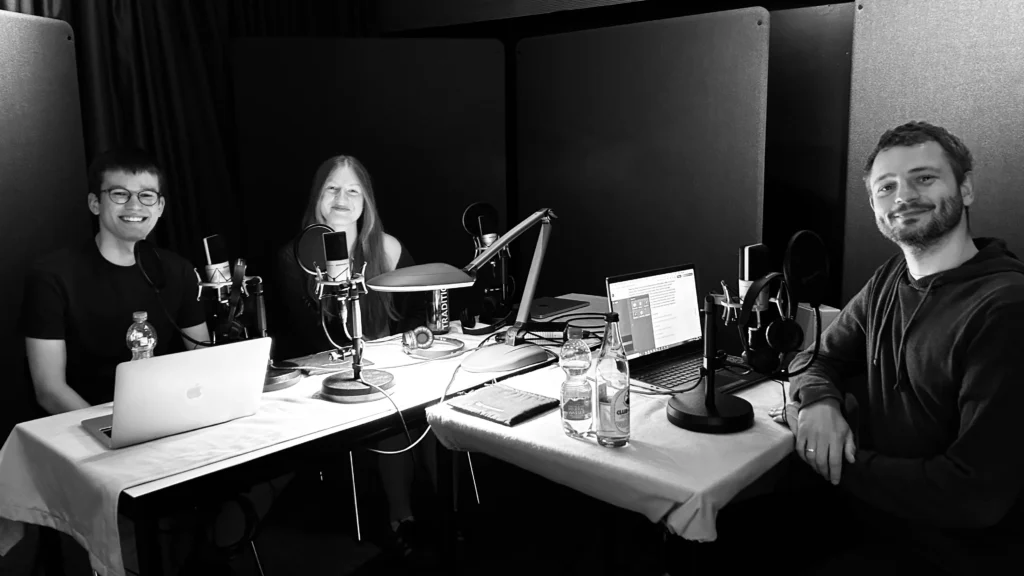
Episode 5 | Published on July 30, 2026
In this episode, we talk with Prof. Fritz Günther about how language shapes our thinking. Together, we discuss the psychological perspective on language research, the role of swear words, the approach of computational modeling, and the use of large language models.
“In psychology, it’s not just about what a word means, but also about what happens in people’s minds when they hear that word.”
“I can’t telepathically place the image in my head into yours. So I have to create something that symbolizes this meaning. That can be language.”
“Language matters. Word choice, how we express ourselves, and the way we refer to people are important and shouldn’t just be brushed aside.”
This episode’s guest is Prof. Fritz Günther.
Prof. Fritz Günther is Visiting Professor of Psychological Methodology at Humboldt University of Berlin and head of the junior research group “Computational Modeling” (currently on hold). His research focuses on, among other things, how our experiences and linguistic patterns shape our thinking, and how computational models and large datasets can be used to study how the human brain processes meaning.
Here you can find more information about our guest:
Website: www.fritzguenther.de
HU website: https://www.psychologie.hu-berlin.de/de/mitarbeiter/1693894
List of publications: www.fritzguenther.de/publications/
The conversation in this episode is led by the podcast hosts Tara Liese and Malte Cox. This episode is in German.
We would like to thank our guest Prof. Fritz Günther very much.
Guest
Interview with Prof. Fritz Günther (May 27, 2026, Menschlich Podcast)
Sources
1. Works by Prof. Fritz Günther
www.fritzguenther.de/publications/
2. Ferdinand de Saussure: “Arbitrariness of language”
de Saussure, F. (2011). Grundfragen der allgemeinen Sprachwissenschaft (H. Lommel, Trans.; C. Bally & A. Sechehaye, Eds.). De Gruyter. https://doi.org/10.1515/9783110870183
3. Study on swear words
Sulpizio, S., Günther, F., Badan, L., Basclain, B., Brysbaert, M., Chan, Y. L., Ciaccio, L. A., Dudschig, C., Duñabeitia, J. A., Fasoli, F., Ferrand, L., Filipović Đurđević, D., Guerra, E., Hollis, G., Job, R., Jornkokgoud, K., Kahraman, H., Kgolo-Lotshwao, N., Kinoshita, S., … Marelli, M. (2024). Taboo language across the globe: A multi-lab study. Behavior Research Methods, 56(4), 3794–3813. https://doi.org/10.3758/s13428-024-02376-6
Kassam, A. (2025, 19. Oktober). Italian blasphemy and German ingenuity: how swear words differ around the world. The Guardian. https://www.theguardian.com/science/2025/oct/19/italian-blasphemy-and-german-ingenuity-how-swear-words-differ-around-the-world
4. Steven Pinker: “Euphemism Treadmill”
Pinker, S. (1994, 5. April). The Game of the Name. The New York Times. https://www.nytimes.com/1994/04/05/opinion/the-game-of-the-name.html
5. “Swinging Lexical Network” model of language production
Abdel Rahman, R., & Melinger, A. (2009). Semantic context effects in language production: A swinging lexical network proposal and a review. Language and Cognitive Processes, 24(5), 713–734. https://doi.org/10.1080/01690960802597250
Abdel Rahman, R., & Melinger, A. (2019). Semantic processing during language production: an update of the swinging lexical network. Language, Cognition and Neuroscience, 34(9), 1176–1192. https://doi.org/10.1080/23273798.2019.1599970
6. Overview of current research projects by Prof. Fritz Günther
What’s in a name? Computational modeling and experimental investigations on the non-arbitrariness of word label choices: https://gepris.dfg.de/project/459717703?lang=en
A computational implementation of the Swinging Lexical Network model of language production: https://gepris.dfg.de/project/532390335?lang=en
Measuring Semantic Similarity in Bilinguals and Language Models (MESSI): https://gepris.dfg.de/project/566296599?lang=en
A multidimensional adaptive test for the psychometric assessment of LLM capabilities: https://gepris.dfg.de/project/578866898?lang=en
